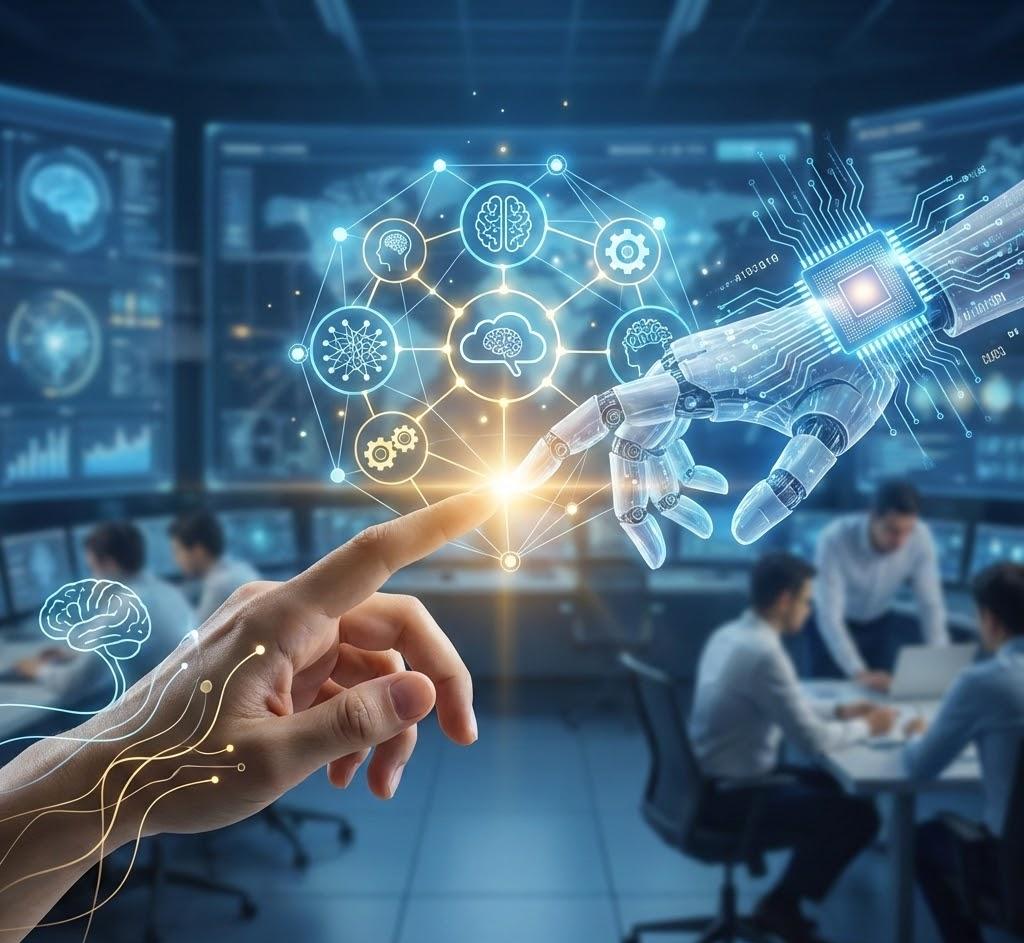
In the age of technology, competitive advantage is no longer determined by access to information, but by how you process that information. Artificial intelligence systems can analyze millions of data in seconds, but making sense of the data, putting it into context and turning it into strategic decisions still relies on human judgment. This is where the hybrid intelligence approach comes into play: Bringing together the human mind and the analytical capacity of artificial intelligence in the same decision architecture. The goal here is not an “either human or artificial intelligence” dilemma, but to establish a collaborative working order that enables both to produce better results together.
Hybrid intelligence systems work on the principle of complementarity. Artificial intelligence is strong in big data analysis, pattern detection, prediction, classification and optimization. Humans, on the other hand, excel in areas such as intuition, ethical evaluation, empathy, creativity, uncertainty management and goal prioritization. When these two competencies come together, decision processes become both faster and more balanced. In practice, hybrid intelligence often proceeds in a four-layer flow: In the first layer, data is collected and cleaned from different sources; in the second layer, artificial intelligence extracts meaningful signals from this data, generates predictions and simulates scenarios; in the third layer, the human expert filters the resulting recommendations in terms of the organization’s goals, reality on the ground, legal/ethical limits and risk appetite; in the last layer, the results of the decision taken are entered into the system as feedback and the model becomes more accurate over time. Thus, instead of a one-off analysis, a continuously learning decision cycle is established.
The power of this approach is clearly visible in different sectors. In healthcare, artificial intelligence can offer highly accurate recommendations for early diagnosis, but the patient’s clinical history, living conditions and the ethical dimension of treatment options are evaluated by the physician. In finance, algorithms optimize risk distribution and generate probability scenarios from market movements, but it is human leadership that determines the investment strategy and knows the vision and long-term goals of the institution. In education, AI measures student strengths and weaknesses to create personalized learning roadmaps, while the teacher manages motivation, classroom dynamics and pedagogical approach. In agriculture, models working with sensor, drone and satellite data can predict yields; however, critical details such as land conditions, local climate realities and the opportunities of the producer are complemented by human experience.
Hybrid intelligence is not only a “support tool” that increases productivity; it is a governance approach that improves the quality of decisions when it is designed correctly. Human biases can be balanced by data-driven analysis, while algorithmic biases from the model’s dataset can be controlled by human oversight. This bidirectional control mechanism is especially critical in high-impact areas such as public administration, credit assessment, recruitment, health, education, etc. Hybrid systems also emphasize the need for “explainability”: Making it understandable why AI recommends what it recommends, and recording the reasons why humans accept or reject it, strengthens institutional memory and increases accountability.
For organizations of the future, it is not just about investing in AI; it is about designing the right division of labor between human and machine. Successful hybrid intelligence models position AI as a powerful analysis partner, not a decision maker. The human is the party that sets the goal, weighs the risks, draws the ethical framework and assumes ultimate responsibility. For this reason, hybrid intelligence is a partnership model that expands human capacity rather than replacing it. And the real transformation begins not by polishing technology on its own, but at the point where we can position it as a system that works together with the human mind.